Part B
THE PROCESS
INTRODUCTION
Our project focuses on creating an interactive eBook for children aged 4–8, inspired by the historical epic Mahabharata. The aim is to simplify and present the story's core lessons of righteousness, honesty, courage, humility, and fairness through short, engaging narratives designed for young minds.
The project approaches the Mahabharata through its human experiences and ethical choices, emphasizing values rather than depicting war or divinity.
By merging UX design, child psychology, and cultural education, the project transforms a timeless narrative into an accessible learning experience for early learners.
PROJECT OVERVIEW
20 pages
An interactive storybook retelling selected Mahabharata stories for children aged 4–8.
Short + visual
Each story is short, colorful and easy to follow — highlighting truth, empathy, courage and fairness.
Learning + play
Read-aloud narration, gentle animations and moral highlights let children control the reading experience.
UNDERSTANDING THE USERS
Visual & Sensory Processing
Over 70% of children's early learning occurs through visual input (APA, 2021). Children remember 80% of what they see and do, compared to only 20% of what they hear (NIEER).
Emotional & Imaginative Thinking
Emotional and imaginative thinking drives how children form values. Facial expressions and motion cues build social-emotional intelligence — critical to early moral development (UNICEF).
Memory, Comprehension & Moral Recall
Children remember story-based morals up to 4 times longer when accompanied by simple imagery and emotional tone consistency (Stanford GSE, 2018).
Age-Specific Cognitive Characteristics
Attention spans average 10–15 minutes (APA, 2021). Children prefer sequential narratives with clear beginnings, problems and resolutions, and moral development is guided by fairness and consequence.
Why eBooks Work for Children
Read-aloud narration supports pre-readers; touch interaction engages the sensorimotor loop; self-paced navigation builds decision-making and autonomy — children gain confidence when they control the reading experience.
CURRICULUM ANALYSIS
Existing Educational Focus
- Early-grade education prioritizes language, arithmetic and basic moral science
- Cultural education is minimal — often limited to festival references
- Storybooks are mostly non-interactive and imported in style, lacking Indian context
Gaps Identified
- Limited exposure to culturally rooted moral education
- Lack of interactive or visual storytelling designed for comprehension and empathy
- Minimal bilingual and audio-assisted material for early readers
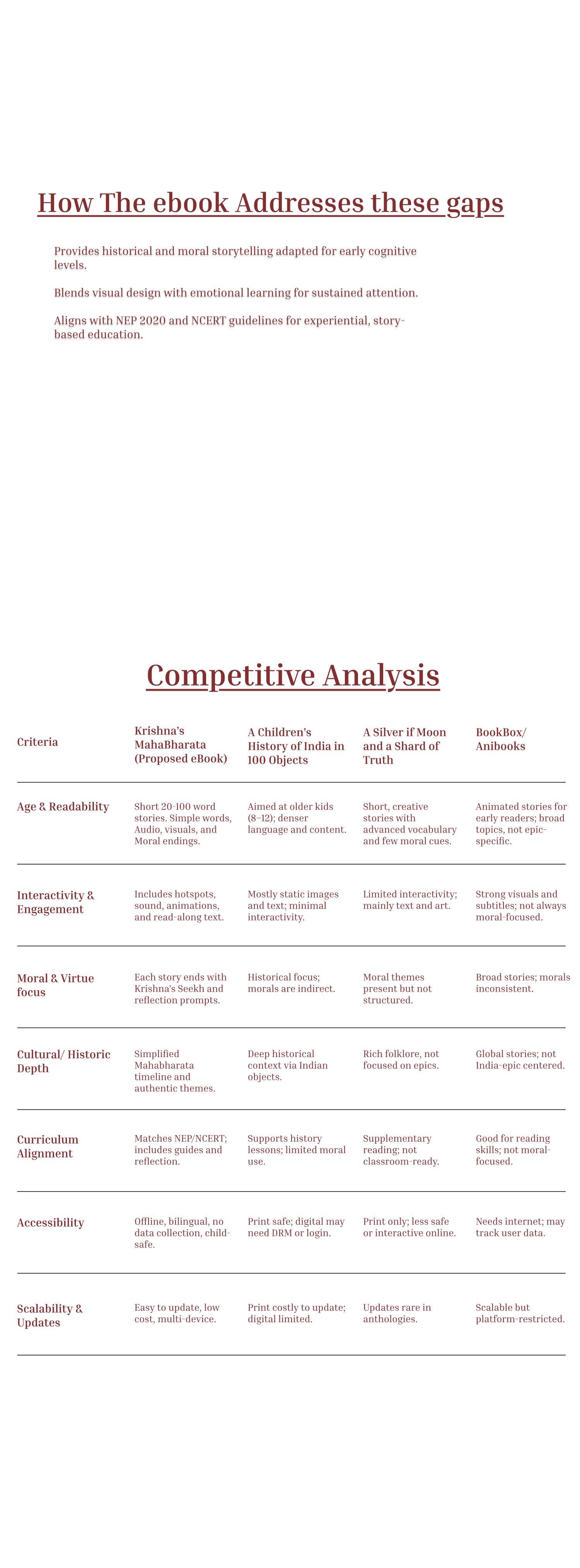
How the eBook Addresses These Gaps
- Historical and moral storytelling adapted for early cognitive levels
- Blends visual design with emotional learning for sustained attention
- Aligns with NEP 2020 and NCERT guidelines for experiential, story-based education
COMPETITIVE ANALYSIS
The proposed eBook was compared against three existing story platforms across seven criteria.
USER RESEARCH
Parent Questionnaire
- Can you tell me a little about your child — how old they are and what kinds of stories or shows they enjoy the most these days?
- What makes you feel a story is good for your child — is it the message, the fun, the language, or something else?
- How do you feel about your child using digital screens for reading or learning — what works well, and what doesn't?
- Do you think traditional or cultural stories, like those from Indian mythology, still interest children today?
- When your child reads or listens to stories, what helps them stay focused or excited — visuals, voice, short chapters, or interaction?
Child Questionnaire
- Can you tell me what kind of stories you like the most?
- When someone tells you a story, what do you like most about it?
- Do you like reading or listening to stories on a phone or tablet?
- What makes a story fun or interesting for you?
- If you could make your own story, what would it be about?
- Follow-ups — “Who\'s your favourite story character?”, “Do you like stories that make you laugh or ones that teach something?”, “Do your parents read you stories?”
USER PERSONAS
Krrish Nautiyal
7-year-old child — Dehradun
A curious 7-year-old who prefers lively, visual and interactive stories over reading long text.
Core Needs
- Stories that move fast and match his short attention span
- Simple storylines with clear heroes and adventurous elements
- Books with bright and frequent imagery
Pain Points
- Gets bored quickly when there's too much text or narration
- Finds regular eBooks dull and long compared to videos or games
Mandira Nautiyal
35-year-old working mother — Dehradun
A mindful mother seeking safe, meaningful digital stories that blend fun with learning.
Core Needs
- Digital content that keeps her son engaged but still teaches something good
- Stories or interactions that are not unhealthy, addictive or attention-eroding
- Modern educational storytelling that helps develop reading habits
Pain Points
- Most apps her child engages with are loud and overstimulating
- Finds it hard to strike a balance between screentime and learning
Rajesh Dhingra
58-year-old teacher — Dehradun
A dedicated teacher who uses storytelling to teach morals and wants engaging, culturally rooted digital tools for his students.
Core Needs
- Digital materials that teach traditional values without overstimulation
- Stories that blend culture, values and meaningful knowledge
Pain Points
- Notices children becoming less patient with slow, reflective storytelling
- Lacks access to interactive Indian story resources suited for classroom use
EMPATHY MAPS
Krrish
Says
- “Can we watch instead of reading?”
- “I like when there are superheroes and magic.”
Thinks
- Reading long text is boring and tiring.
- Games and videos are more enjoyable than regular eBooks.
Does
- Skips pages to look at pictures instead of reading.
- Stops reading midway if the text is too long.
Feels
- Excited by colorful visuals, magic and superheroes.
- Bored when nothing interesting happens quickly.
Mandira
Says
- “I want screen time to be meaningful, not just entertainment.”
- “Most kids' apps are too loud and overstimulating.”
Thinks
- Fun and values can go together — it doesn't have to be one or the other.
- Safe and culturally rooted content is missing in current apps.
Does
- Monitors and limits her child's screen time.
- Actively searches for calm, meaningful storytelling formats.
Feels
- Worried about the effects of overstimulating digital media.
- Proud when her child learns good values through stories.
Rajesh
Says
- “Stories should teach values, not just entertain.”
- “It's hard to find Indian cultural stories in interactive formats.”
Thinks
- Culturally rooted learning is important for character development.
- Storytelling should build wisdom, not addiction.
Does
- Uses stories to teach morals and creativity during class.
- Encourages students to use screen time mindfully for learning.
Feels
- Concerned about children getting addicted to fast, shallow content.
- Hopeful about digital tools that support education meaningfully.
KEY FINDINGS
STORYBOARD
A child excitedly opens the Mahabharata eBook on a tablet, eager to start reading.
The child explores cartoon-style introductions of the Pandavas and Kauravas by swiping through pages.
The child reads about young Yudhishthira learning honesty, and pauses thoughtfully at the lesson.
The child watches a simplified dice-game scene and learns that greed can lead to problems.
The child views a bright, non-violent illustration of Kurukshetra showing bravery and teamwork.
The child taps to hear Krishna guiding Arjuna about courage and doing the right thing.
The child reaches the ending and learns that honesty, kindness and hard work always triumph.
The child proudly closes the eBook and shares what they learned with a parent or teacher.
FINAL UI
How the design came together on screen.
Story pages
Short sentences, vivid illustrations and rhythmic narration keep every page light and engaging.
Read-aloud
Audio narration supports pre-readers and keeps the experience hands-free when needed.
Moral moments
Each story closes with a positive, affirming moral — never punitive — providing closure and comfort.
Simple navigation
Rounded buttons and clear icons for next, audio and replay keep children in control.
“Peace was offered,” he said softly, “but pride refused it.”
From the story — Krishna's message of peace
PROTOTYPE
Move through the eBook exactly as a child would — tap, listen and read along.
TAKEAWAY
“This project helped me explore how research, storytelling and visual design can work together to make a digital learning experience feel more engaging and approachable for children.”
Next Project
01HATASU